

University of Sannio, Benevento
Fluid & energy systems, made intelligent.
FP smart LAB develops intelligent technologies for pneumatic, hydraulic, hydrogen and technical-gas systems, combining physics-based modeling, advanced sensing and experimental validation — from individual components to complete plants.

Intelligence from the component to the plant.
Every fluid system is treated at three scales — component, machine, plant — with one chain of tools: coupled 3D-CFD → 0D/1D models, our own digital-twin software, and experimental validation on our benches. Compressed air is where the chain is proven today.
{{ r.title }}
From the model
to the test bench.
Modeling, test facilities and experimental validation on the University of Sannio fluid-power benches — where every model is taken to a bench before it is taken to a plant. Joint R&D and pilot installations.
Case studies.
Publications & patents.
Researchers who decided to build.
Intelligence from the component to the plant.
Every fluid system is treated at three scales — component, machine, plant — with one chain of tools: coupled 3D-CFD → 0D/1D models, our own digital-twin software, and experimental validation on our benches. Compressed air is where the chain is proven today.
{{ s.name }}
{{ s.desc }}
From the model to the real world.
Simulation → sensing → testing → optimisation. Each technology feeds the next: models are validated on the bench, sensors are calibrated against the models, and the closed loop is what we deliver to a plant.
{{ t.name }}
{{ t.desc }}
From the model
to the test bench.
Modeling, test facilities and experimental validation on the University of Sannio fluid-power benches — where every model is taken to a bench before it is taken to a plant. Joint R&D and pilot installations.
Case studies.
Intelligence from the component to the plant — compressed air and hydraulics, one case per scale.
Capturing the physics before optimizing the design.
A dedicated R&D methodology for high-Mach-number pneumatic flows.
Inside a pneumatic vacuum generator, compressed air undergoes strong acceleration and expansion. In critical regions, the flow becomes highly compressible and develops shock structures that strongly affect the internal pressure distribution — and therefore the vacuum generated.
Conventional modelling approaches may smooth or miss these discontinuities, producing apparently plausible but unreliable performance predictions.
For this reason, FP smart LAB developed a dedicated physics-based methodology combining high-Mach-number compressible-flow modelling, energy coupling and progressive adaptive mesh refinement.
Resolving the physics
High-Mach-number flow
The internal flow accelerates from subsonic to supersonic conditions, producing strong variations in pressure, density and temperature. The methodology explicitly accounts for these compressibility effects to correctly reconstruct the mechanisms responsible for vacuum generation.


Shock-wave capturing
Shock waves introduce sharp discontinuities in the flow field. Their position and intensity can significantly influence the pressure distribution inside the device. If they are not correctly resolved, the predicted vacuum level and suction performance may become unreliable.
Adaptive Mesh Refinement
A progressive Adaptive Mesh Refinement — AMR — strategy is used to increase numerical resolution only in the regions where the strongest flow discontinuities develop. Instead of uniformly increasing computational cost, the mesh is progressively refined around the relevant shock structures until the dominant physical phenomena are correctly captured.
From flow physics to design knowledge
Once the high-speed flow was accurately reconstructed, the methodology was used to understand how different regions of the internal geometry influence different performance targets. The analysis identified a clear functional separation:
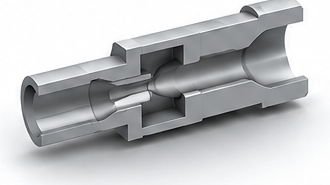
Mainly governed by the geometry of the primary expansion and mixing region.
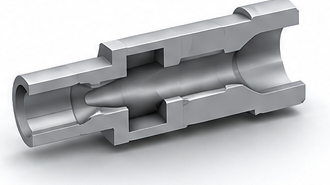
Strongly influenced by downstream interaction and entrainment mechanisms.
This physical understanding makes it possible to optimize the component through separate but coordinated design objectives, rather than treating the geometry as a single undifferentiated parameter set.
Multi-objective optimization
The resulting methodology simultaneously considers: Vacuum level · Suction capacity · Compressed-air demand. The objective is not simply to maximize one performance indicator, but to identify design modifications that improve the useful operating characteristics of the component without introducing an undesirable increase in energy demand.

What we reuse
Not just an optimized geometry. A methodology built around the physics of the component.
Publications & patents.
Researchers who decided to build.
Tell us what flows through your plant.
fpsmartlab.com
Benevento · Italy
Tell us what flows
through your plant.
University of Sannio, Benevento